
Quarterly BITSian
Quarterly BITSian – Dr. Guri Sohi
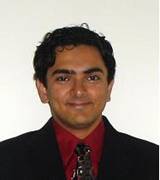 Interviewer's Note
Dr. Guri Sohi, BITS-Pilani Alumni, ID 76F06954, elected member of the US National Academy of Engineering in 2009, recipient of several prestigious awards and established professor of Computer Architecture at University of Wisconsin Madison, takes time out to chat with Sandpaper regarding his life, his work, his BITS (the one he remembers fondly) and himself. For his tremendous achievement in his field as BITS alum, he is our Quarterly BITSian.
Bhavesh Mehta, 1999A7PS049
Download pdf

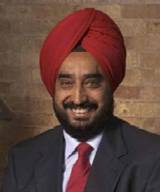
It takes effort and creativity to tread the unbeaten path. To follow your dreams when none else believes in them requires tremendous self confidence. In Dr. Sohi’s own words, “Do things differently. While joining the mainstream has a reassuring feel to it, to really stand out you need to create new approaches to problems. This is difficult if you are constantly surrounded by and work with existing approaches since this naturally results in incremental improvements rather than new directions.”
Dr. Guri Sohi, BITS-Pialni Alumni, ID 76F06954, elected member of the US National Academy of Engineering in 2009, recipient of several prestigious awards and established professor of Computer Architecture at University of Wisconsin Madison, takes time out to chat with Sandpaper regarding his life, his work, his BITS (the one he remembers fondly) and himself. For his tremendous achievement in his field as BITS alum, he is our Quarterly BITSian.
Professional Life
First of all, we take this opportunity to offer our heartiest congratulations on behalf of the entire BITSian community on being elected a member of the US National Academy of Engineering earlier this year. How are you feeling at the moment?
Thank you very much. I am mostly elated. However I do go through a variety of sentiments when I reflect upon the various opportunities that I have been fortunate to have had and without which it is unlikely I would have received this recognition.
For the benefit of our readers, can you tell us more about the US National Academy of Engineering? How is this award special to you?
The National Academy of Engineering (NAE) is an autonomous body of outstanding engineers with the responsibility of advising the US federal government. Membership is by invitation only with new members selected by current members of the academy. It is very special since this is one of the highest professional recognitions that an engineer can receive.
We understand that you are one of the leading researchers in the field of Computer Architecture. Can you please share with us some of your latest research in a few words? What problems are you trying to solve now?
Currently I am working with a very small group of students on trying to propose new directions for making use of multicore processors and understanding the implications the new directions on computer architecture. We are challenging the decade’s old premise that parallel execution requires a parallel program representation and have proposed a new model where we can achieve parallel execution with a sequential program representation, without additional hardware or compiler support. If we succeed at this, we believe we can have a dramatic impact on the design of not only hardware but also on software.
How would you characterize the current state of computer architecture? Could you talk about the pace of innovation, compared with what it was in the past?
We are now at a point that innovations in computer architecture are even more important. The rate of improvement in processor clock speeds has slowed down, and thus we have to put an even greater burden on improving parallelism (via computer architectural and micro-architectural innovations) to continue to get increased performance. We will also require a plethora of computer architecture innovations to address new constraints on design, namely power and unreliable hardware components.
Life @ BITS, Pilani
We would like to know certain details of your life at BITS. For starters, what did you do/study at BITS and which batch did you belong to? And here’s something to tickle your memory cells! Do you remember your ID Number?
I was in the batch of 1976. I was a very late second semester admit. I did not get admitted in the first semester, or even in the early rounds of the second semester. That year we had an unusually large number of second semester admissions (over 125 I believe). I was told that this was because the semester-long Practice School had just started and there were several rooms in the bhavans available to accommodate students. I was admitted in the 3rd or 4th round of second semester admissions, and I actually got my admission letter, and joined BITS, a week or two after the semester had started. So technically I was admitted at the bottom of the 1976 batch. I used the opportunity given to me to study hard and ended up graduating as the Gold Medalist in 1981.
I started out in Ram Bhavan, in the wing facing the Ram/Budh mess. I ended up studying Electrical and Electronics Engineering (EEE) and ended up in Rana Pratap Bhavan along with the other EEE majors. At that time rooms were assigned according to CGPA. I was in the wing that many others referred to as the “high tension” wing. I had a wonderful group of wing mates. I met a couple of my wing mates in Chandigarh and several of my batch mates in Delhi in July. I hadn’t seen most of them since we left Pilani and it was wonderful reliving the memories.
I do remember my ID number. It started out at 76XXX954 and ended up being 76F06954.
What are your three best memories of your time at Pilani?
Well, there are too many: relaxing in the museum lawns on a sunny winter afternoon, strolls along Shiv Ganga, aloo tikkis at the rehri, samosas at the Post Office canteen, paneer pakoras at Connaught, “espresso” at Nutan, gliding with Mr. Sukumaran, and a host of others.
Do you remember any particular event that you would like to share with us?
That is a hard one. But listening to Ravi Shankar play into the dawn at the Audi was certainly memorable. Then there is the forgettable: the infamous strike that our Student Union called. After a while, most of the student leaders had skipped town as had the “guards” who would go to the train station at Loharu to make sure that other students weren’t leaving. Only a few of us were left at Pilani at the end before sanity returned.
We’d love to hear about your activities and some [any?] courses you liked at BITS?
It has been a very long time so I can’t remember all the courses I took. I did enjoy most of them. I drew a lot of inspiration from linear algebra, control systems, and electromagnetic and a variety of other courses.
Tell us a little about the transition you made from India to the US? What surprised you? What did you like the most and intensely dislike?
It was a real culture shock when I first left India. The journey itself was very interesting: I was travelling with another BITsian who was also attending the University of Illinois and ours was the first flight from Frankfurt to Chicago after the strike by the air traffic controllers in the US. I was afraid that we might get stuck in Germany and run out of money (we both had only about $600 each, which was close to the maximum amount of foreign exchange that we could get at that time). And then there were complications with not knowing how to use a phone, how to order food in a cafeteria or at McDonalds, or not knowing that the shower curtain should be inside the tub and not outside when taking a shower, but those stories are for some other time.
I was pleasantly surprised by the very warm welcome that I received from the students and faculty at Illinois. They went to great lengths to make me feel comfortable. There was a good sized community of Indian students at Illinois and we would have a great time when we were not studying.
Initially I greatly disliked the bitter cold in the winter at Illinois. But now the winters in Illinois are warm in comparison to Madison, Wisconsin, where I currently live. I liked almost everything else, especially that one could buy ice cream by the gallon, and it was quite cheap.
Advice & Feedback for BITS students & alumni
What do you think are the biggest challenges facing BITS today?
Maintaining its position as a premier institution of technical education in the global environment. As India continues to advance, it will need premier research universities where the fundamental knowledge that will power future knowledge-based economies will be created. Does BITS want to become a premier research institution? Doing so is quite difficult, and very expensive.
What can BITSians do better/start doing to compete with the world’s best?
I think they are doing a wonderful job already.
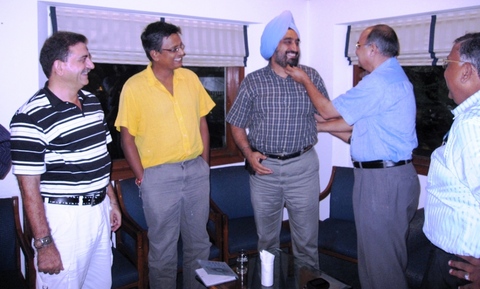
Guri Sohi at an Alumni Reunion
What role do you see the alumnus playing in making BITS a world-class institution?
Alumni are critical to the success of world-class institutions. They can contribute in a variety of ways including mentoring faculty and students, creating a network of resources which can be used by faculty, alumni and students, as well as contribute financial resources. As an example, my batch mates in Silicon Valley helped the AcYut Robot team in its initial stages and look how that initial engagement has helped.
The leading private US universities owe a lot of their success to the benevolence of their alumni. In fact, BITS owes its existence to the benevolence of the Birlas. Going forward, the engagement and benevolence of alumni is going to be very important.
You received the 1999 ACM SIGARCH Maurice Wilkes award, won the WARF Kellett Mid-Career Faculty Researcher award in 2000. You were selected as a Vilas Associate in 1997, and a WARF Named Professor. To put it as a cliché, “What was the secret behind your success?”
Frankly I don’t know. Maybe it was being at the right place at the right time. But I always pursued a path that was different from the mainstream and was fortunate to have mentors who encouraged me to pursue such paths. I try not to join the crowd and this has helped me look at problems in different ways.
I was like this at BITS too. Frequently I took classes from professors who weren’t the popular professors, i.e., those whose classes everybody wanted to attend. I remember many lectures where there were only 2-3 students in the class and even a few where I was the only one. But I learned a way of looking at problems from instructors such as Sampuran Cheema, Mohi Mukherjee, H. Subramanian and others that I doubt I would have learned had I been in the crowded classes of the popular professors.
Would you like to give some advice to BITSians aspiring to lead and reach top positions one day?
Do things differently. While joining the mainstream has a reassuring feel to it, to really stand out you need to create new approaches to problems. This is difficult if you are constantly surrounded by and work with existing approaches since this naturally results in incremental improvements rather than new directions.
Have you ever worked with business professionals from Pilani or even India? What are your impressions of them in terms of leadership skills or technical abilities?
Not really since my job a professor rarely leads to such situations. My classmates and other friends from BITS are doing a fantastic job, both technically as well as in leadership roles, all over the world. Clearly BITS did something right!
How do you think we (BITSians/Indians) are distinguishing ourselves? What do we need to be doing better?
Absolutely! It is hard to think of any general suggestion for improvement. In my opinion, two skills will be critical going forward in a global technology environment: cultural sensitivity and understanding and communication skills. So if anything, I would suggest improving these skills.
Personal
Have you been back to Pilani since you graduated? If so, how was the visit personally and professionally? If not, do you ever intend to go back?
Unfortunately, I have not. And I regret this. I hope to go back before too long.
What do you read to stay in touch with technology, business other fields that interest you?
Being in a university one is constantly exposed to lectures and seminars on advances in technology well before they enter the market. So that is how I keep in touch with technology. For other matters, I try to spend some time every day reading on-line newspapers such as the New York Times and the Chandigarh Tribune.
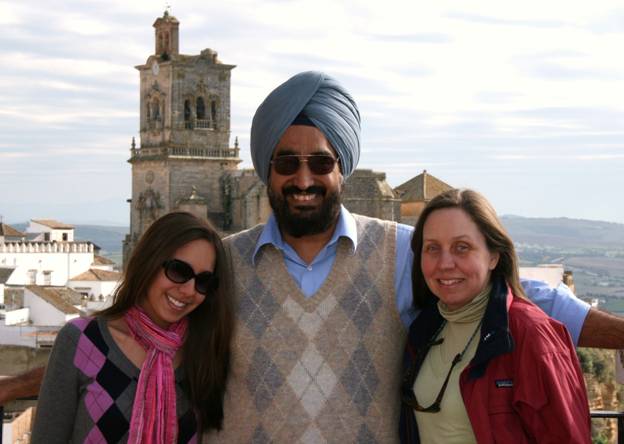
Guri Sohi with his wife Marilyn and daughter Jacinth
What are your hobbies, interests etc.?
I like to travel. When I can’t travel physically, I try to travel “virtually”, i.e., read about travel possibilities.
Tell us something about your family and Madison - where you live.
I have been married for 24 years to my wife, Marilyn, who I met when we were students at the University of Illinois. We have one daughter, Jacinth, who is a junior at Claremont McKenna College in Southern California and we have a West Highland Terrier dog named Annie.
Madison is a wonderful and cosmopolitan city. It is the capital of the State of Wisconsin and is also home to the University of Wisconsin. One of the lesser known facts is that one of the heroes of India, Jayaprakash Narayan, attended the University of Wisconsin, and his tenure here had a formative impact on his political philosophy.
Opinion
A lot of people are skeptical about the use of multicore chips with increasing number of cores per chip. A lot of focus in research has shifted to programmability of these chips. Is research in Computer Architecture becoming less interesting?
Clearly the number one issue going forward is the programmability of multicore chips. Without this, it is hard to make full use of the chip. However, I believe that we will come up with novel ways of achieving parallel execution on multicore chips, without dramatic changes in the ubiquitous sequential programming paradigm. I believe this will result in a significant change in the architecture of the multicore processors. Let us also not forget that the new design constraints of power and reliability will continue to call for innovations in computer architecture to tackle them. In fact, as we run out of other technology scaling approaches to address problems (such as faster clock speeds to get performance); the burden will be on computer architecture to provide additional approaches. When new technologies replace current semiconductor technologies, the job of building computing machines with new technologies will fall on computer architects.
What do you think is next big thing in computers?
My guess is that it will be in opening up entirely new application areas as a result of transforming traditional ways of doing things. But what areas? There will likely be significant new applications that come about as computers transform traditional biology, medicine, health care and the like. For example, a century ago physics and chemistry experiments were done in the laboratory. Today many of them are simulated on computers. Today most biology experiments are done in labs. I suspect many of them will be done via computer simulations once we develop the necessary models for biological processes. Another big area is gathering knowledge from information. Today’s search engines have completely transformed traditional avenues for information but they are still rudimentary when it comes to extracting useful knowledge. I envision significant opportunities for advances in this area. There are many others. We are just scratching the surface.
Anything else you’d like to share with us?
One does not realize how special a place BITS is until long after one has left. I am fortunate to have been able to get the opportunity to study at BITS.
