 |
||
 |
|
||||||||||
|
||||||||||
|
bitsaa.org BITS Pilani |












Person of the Month
Sept / Oct 2003: Dilip D'Souza, Writer PDF
When I met Dilip in
Name: Dilip D’Souza
Books: The
Regular
Columnist: Rediff
Institutions :
Seeds for Peace
Tell
us about your experience at BITS. Do you have any fond memories you'd like
to share with us?
The first lesson I
learned, and very quickly, was that my city boy pretensions were just
those: pretensions. At BITS I met guys from every corner of the country,
many of whom were not fluent in English, but who proceeded to beat the
pants off me in our courses nevertheless. A sobering, but necessary lesson
for me. It was from them that I learned the true meaning of the word
"cosmopolitan" -- for this was a cosmopolitan place in the best
sense. BITS was probably the first time I truly understood what my country
was about, and it's something I haven't forgotten.
There are all kinds
of fond memories! The joy of friendships, the aching tenderness of first
love, the untouchable thrill of finding what you're good at (and bad at,
for that matter) and doing well at it ... and then I ran for President of
the Union. Promised helipads in each Bhavan, promised to move the clock
tower to the Main lawns so the time would be better visible from all over
the campus, and collected all of 17 votes. I'm still trying to find out
who the other 16 dodos were.
You
have written two great books about two great causes. Tell us about these
books.
"Great"
is a word I quail from! But thank you nevertheless. I put a lot into them
and I think they are good books. I'm dejected that they haven't been more
widely read. But I suppose that's the way it goes. Anyway.
My first book,
"Branded by Law", is about our "denotified", or
ex-criminal tribes. There are about 150 of these communities spread around
the country. In 1872, the British passed the Criminal Tribes Act which
actually listed ("notified") these tribes and therefore defined
them as criminal. That is, if you were born into one of these tribes, you
were automatically considered criminal. In 1952, independent
When I was done
with writing that book, someone from Penguin approached me to write about
the
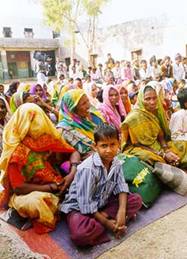
Denotified Tribes
I'd
like to hear about your most cherished moment from both projects.
This happened in
1998, when I visited a tiny town called Santrampur, in Panchmahals Dist in
There, beyond a
strip of black stinking ooze from a broken drain, beyond a huge pile of
garbage and set in some thorny bushes, were a few thatched huts. I went
with Deepak to his hut, said namaste to his wife and daughter, bent down
to look in and commented involuntarily on how neat his hut was. That was
all I did.
Then we started
walking back to the meeting, because I had to meet my colleagues and
return to
This is what I
wrote in my book about this moment: "I
was speechless. Astonished, too, at how close to tears I suddenly was. It
was both a compliment I will always treasure, and the saddest thing I have
ever heard. All I had done was spend a few minutes with Deepak, as I might
have with anyone else. Yet his few words told me just how novel an
experience even that much was for him."
As for the
It was a truly
inspiring moment on many levels. I found myself wishing that more of us
from BITS -- me, for one -- would choose to go do things like this pair
from Kerala had. I can't think of a better use of the education we were
privileged to get there.
You
once wrote about 10 great reasons why you want to live in
Listening to the 10
reasons or to the ills and injustices?
More seriously.
Yes, I suppose some people are listening, but not enough, and not enough
who are in positions of power. But that's the challenge every writer
faces: to write effectively so that people will listen. It's my challenge
too, and it's what drives my writing. There are times I fail, sure, but
that only means I need to try harder next time.
Your
next project concerns
The next project I
want to work on concerns patriotism, war and dissent.
So I am interested
too in the tragedyof
Tell
me something about your family. Is your wife your biggest critic ?
I met Vibha Kamat
in 1992, about 6 months after my move back from the States. (Meeting her
is, of course, the best thing I've ever done in my life...). We were
married in December 1993. Our son Sahir was born in June 1999. We are
getting ready to submit our application to adopt a second child. Vibha
grew up in
(c) Copyright 2003 BITSAA International Inc.